How I would learn to Trade if I started over again
July 1, 2026 · 35 min read
As I am putting this portfolio website together, I have had a chance to reflect on my retail trading journey. I started off taking a pure engineering approach to it, then as I progressed, I took more of a financial approach, now I'm sitting somewhere in the middle, trying to slowly automate strategies I come up with through my own experiences in the market.
It has not been an easy journey for me, and I'm still nowhere near where I want to be. I am very much still a beginner, but I think trading is one of those things where even going from 0 knowledge to beginner is a commendable journey. So let's get into it!
Get Your Priorities Straight
The first thing you have to do when starting to trade is to manage your expectations, and align your goals. My biggest problem when I started was being unable to decide if I wanted to be a quant or a trader. I tried to solve everything with technology, even when it wasn't necessary. The uncomfortable truth I kept ignoring is that being a quant and being a retail trader were just two entirely separate pursuits. I tried to mold trading into something that was convenient for me, I had misaligned goals, and I wanted a lot of time. I would have had a better chance becoming a quant by getting a PhD in math than learning to trade.
While it is possible to implement you're own algorithmic trading at home, there is a lot of overhead, and you will be putting in a lot of hours and money before you get anything out of it. To get a good picture of how quant firms operate I'd recommend skimming through the opening chapters of Advances in Financial Machine Learning by Marcos López de Prado. If you want to simply make money from trading, I'd scrap the quant part all together at the start. It just adds another layer of complexity and weight that takes away from the thing you are trying to achieve. This was a very hard lesson for me to learn, because the whole reason I got into it in the first place was because I wanted to put my software engineering degree to use. Learn to trade first, put in the reps, then use software as support.
Algorithmic Trading- Research vs Execution
If you look at the job posting of any big quant firm, you will see that strategy research and algorithm execution are often separate jobs. When I interned at BMO, much of their main algorithmic trading software was actually outsourced. A sort of plug and play market making software, the job of the people on the floor was to step in if anything unexpected happened. And the job of the "quants" was supplemental data aggregation, for instance updating the cointegration ratios of different securities, and tweaking other parameters in the execution code. I say this, not to shame anyone (in fact I think outsourcing execution is a better choice for them anyway), but just to give you an idea of how hard it is to "build your own trading system at home". Institutions with much more resources than you and I decide to buy software instead of building it, and if you want to trade algorithmically at home, you have to do both the research and the execution.
Technical vs Fundemental Trading, Investing vs Trading
When I was learning to trade, it felt like the first way you had to classify yourself was whether you were a fundamental analyst or a technical one. Did you hang a picture of Warrant Buffet over your bedpost and fall asleep listening to the Intelligent Investor? Or did you scroll r/wallstreetbets, equip every indicator under the sun, and justify risking 10,000 because the wick of a particular candlestick was rather long. The first thing I failed to understand is that investing alone will never make you rich. You can be a great investor, but if you wanted to turn 30K into a million, you're better off opening a business than investing in stocks. The reason for this is because the returns must scale linearly with risk. The primary goal of investing is to control risk, but that naturally means controlled gains. In trading, you can make as much money as you can lose. It can make you rich, but you might lose your mind and blow up a couple of accounts in the process.
Let's talk about fundamental investing. Think balance sheets, earnings reports, and valuations. You are deciding to buy a stock the same way you would buy a used car. It has a certain spec to it, horsepower, heated seats, AWD and from that it has a certain value to you, but also to everyone else (market value). You want to get a "good deal" on it when you buy, you don't want to buy something that is overhyped but doesn't run well. How you determine how much you want to pay for it is up to you. The tricky thing with stocks is that a company is always changing, it’s like if in a couple of years your car decided it wanted to be pink, or that it now runs on diesel, and you can't sell it to Chinese people anymore. As a fundamental investor you are essentially trying to predict the future (price movement of a stock), or at least predict how much other people are going to value a stock. It might seem complicated, but you might find that humans are quite predictable. Oftentimes, being right isn't the hard part. It's waiting for prices to catch up. My dad started off as a fundamental investor. He bought Palantir at 20 dollars, held it as it went down to seven, and luckily was able to recover his investment and get rid of it once the price came back to 20 dollars. The current stock price of Palantir is $130. But his initial investment from 2020 would be down more than 50% until 2024 where it would break even and then explode hundreds of percent going into the following year. If he bet the house on Palantir, I'd be living in a mansion right now. But I'd have to live on the street in 2022, and then decide in 2024 not to get my original house back when given the opportunity. I'm not saying my dad is the perfect investor, I tell this story simply to illustrate the point that fundamental investing can pay off, but not only does it require extensive research and understanding of a company, it also requires a kind of conviction that most people don't have. To continue buying as the price is moving against you, to trust yourself when the market is telling you that you are wrong.
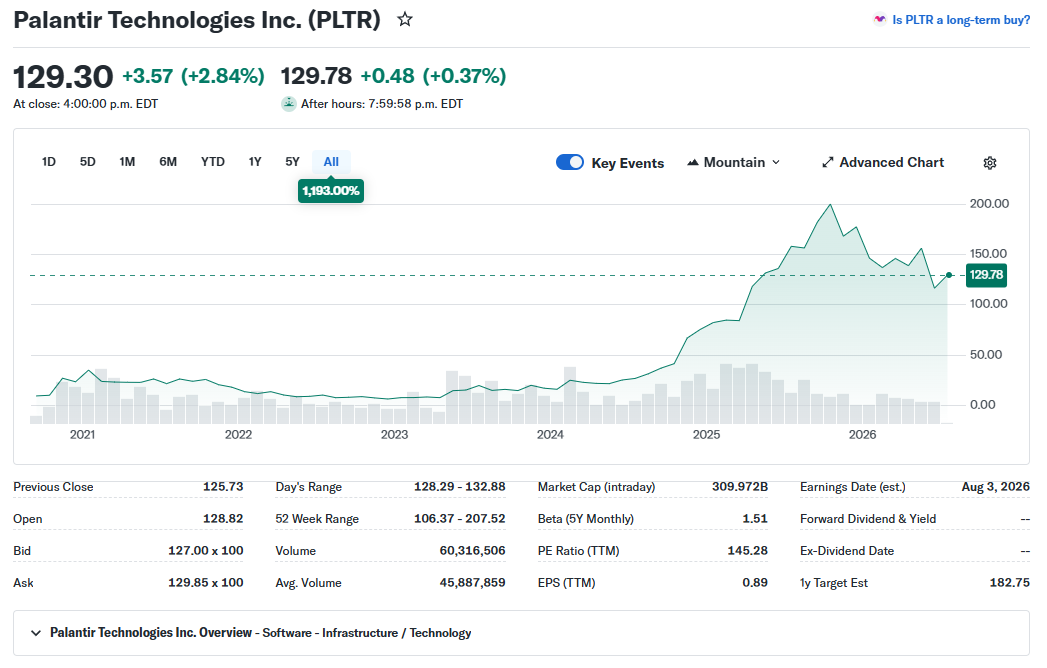
If I were to start my journey over with Fundamental Investing, I would use the following resources: my focus would not be to "make money" or "get rich", it would to become financially literate. To at least gauge the health of the company I'm buying. I use fundamentals as more of a sanity check, than a complete strategy, you can still buy stocks on hype and momentum, but just be aware that the ground you are standing on could collapse beneath your feet. Fundamentals can also be a good way to add stocks that got overly beat up into your buy list, waiting for the downward momentum to die down, then buying a reversal. The main thing I would learn is correlating the earnings and fundamentals of a company to a target price. This gives you an exit price, and a loose risk limit.
- The Plain Bagel (Youtube)
- Henry Chien (Buttonwood) (Youtube)
- Learn/Write my own DCF tool
- Learn to read earnings/ Balance Sheet
- Find key quick ratios ex. P/E, RIOC, CAPEX...
- Find the holdings of insiders (does management have skin in the game)
Unless you know a bunch of Warren Buffet fanboys, your first exposure to investing will probably be technical analysis. The critique is simple: it’s gambling with pretty pictures. You just draw shit on a chart, and sometimes you are right and sometimes you are wrong, but there's no scientific basis behind it. That's what I thought of it for a long time, and that's likely caused by the fake gurus spouting nonsense, and the real gurus, who have working technical strategies, but don't understand the underlying market structure they are actually using. Technical analysis is less about predicting price movements, and more about predicting the intentions of other market participants. It's about identifying liquidity zones, psychologically relevant price levels, and where other people have likely put their stop loss orders. Here's a simple example, if you knew exactly what price the majority of holders of a stock bought at, you would have a good idea if your entry is good or not. You have no way of telling exactly when they will sell, but you have a good idea to be careful if you are buying in at a higher price.
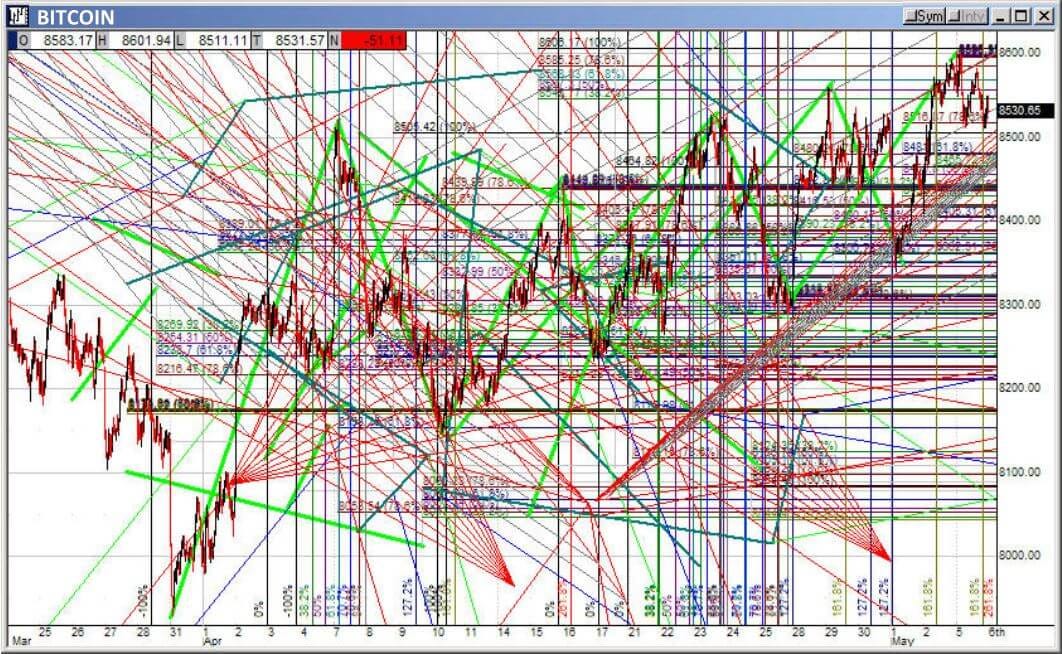
If I were to relearn technical analysis, I would start off with market micro-structure, understand the orderbook and how the buying and selling choices of other traders influence the price of a security. Then I'd understand liquidity, and why sometimes, your orders have high slippage and never seem to fill when you are trying to get into a hot market, and other times fill in the blink of an eye, trapping you in a market moving downward. After internalizing the mechanics that move prices, I would learn market (macro) structure, starting off with the Wyckoff cycle and understanding how big players accumulate positions, push prices up and then sell their positions. Now I’d be looking at things like the volume profile, RSI, price ranges and breakouts, trends. At this point I would focus strongly on how chart patterns correlate to the underlying mechanics and intentions of traders. I wouldn’t focus on memorizing chart patterns, but rather on understanding how intentions can form patterns in price movement. Recalling the micro-structure from before, I would see what weakened buying pressure looks like on a candlestick chart and what strong buying pressure looks like. I would see what it looks like when stocks start to “lose momentum” or “gain momentum”. You stop seeing patterns and start to see what other people are looking at, thinking how the people would react to a certain chart. Thinking how their reactions might change if the next bar was green or red. Lastly, I would learn about options, I would learn about how gamma exposure affects stocks, I would look about implied moves. I would learn about what the options prices say about the market outlook on a given stock.
- The Traveling Trader (Youtube)
- Fractal Flow (Youtube)
- Fabervaale ENG (Youtube)
- Ross Cameron (Youtube)
- Figuring Out Money (Youtube)
- Andrei Jikh (Youtube)
- OpTicBigTymeR (Youtube)
- The Art and Science of Techinical Analysis (Book by Adam Grimes)
- The Unlucky Investor's Guide to Options Trading (Book by Julia Spina)
What about Index Fundes? What about Gold? What about dividends?
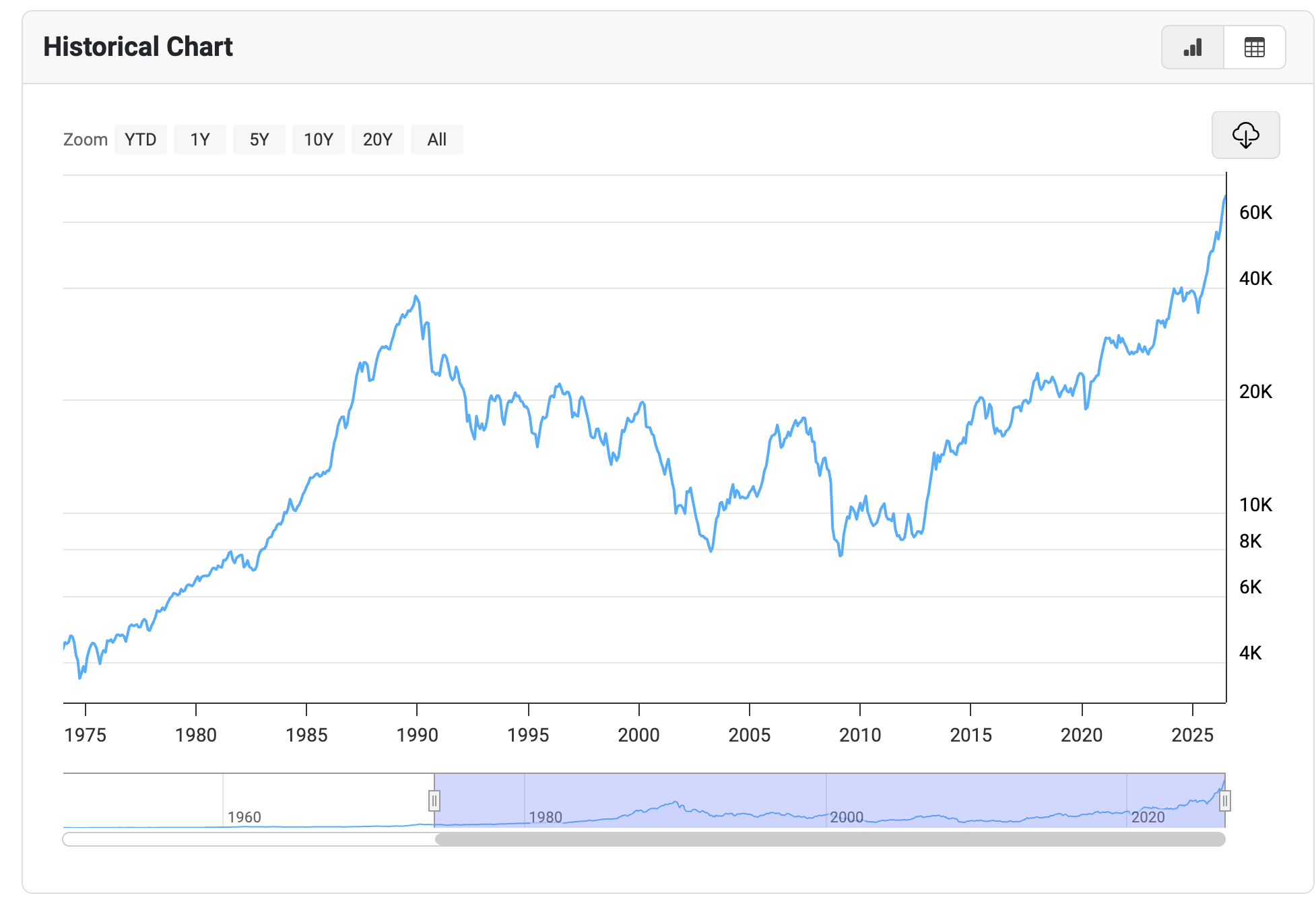
Index funds are great. There's so much youtube slop out there where productivity youtubers spend 35 minutes, talking about "How I would invest in 2026", "How I would invest if I started over again". And its 35 minutes of baby finance compounding interest slop, and 5 minutes of talking about index funds. I'm not against index funds, but before you buy an index fund, it's important to understand portfolio management concepts and exactly what you are exposed to. Even if you accept that you will go with the market and dollar cost average, there are still thousands of ETFs to choose from. It's not as simple as just buying SPY. In fact, as of writing this I could probably build a portfolio of 10 Stocks and have similar (~40%) exposure to SPY at the moment. Then there is the fear of billionaires like Elon Musk being able to game the system, fastracking SpaceX into the QQQ with a “trust me bro" valuation. There is a crowd of people who confidently say that SPY will never die, because it will just simply rotate out losing companies. I say that might not always be the case, let’s take a look at Japan, and its lost decade (now officially a lost 30 years). Many of you reading this, might not have been born yet, I certainly wasn't. But knowing the US genuinely feared Japan taking over all its industries, can give us a good idea of how economically powerful they were. I'm not saying this will happen to the US, but it might not be the global hegemon forever. The point is you can buy index funds, I'm sure they are great, but understand that you are buying a portfolio of stocks, and you should have some understanding of what you just bought. S&P500 is not the only index out there, there are tons. You should have solid reasons as to why you picked a certain one. Why not try building a dividend portfolio, why not buy physical assets, like gold, silver or pokemon cards.
My Case Agaisnt the Effecient Market Theory
There is this theory in markets, called The Efficient Market Theory. Which pretty much states that it's impossible to consistently beat the market (generate a higher return than SPY). The theory states that the current price of assets reflects all available information about that asset. It's then divided into Weak Efficiency, which states that the current price reflects all the information gained from past price. Essentially stating that technically analysis- generating insights just based on price doesn't work. There is Semi Strong Efficiency which states that all publicly available information is reflected in price, balance sheets, news articles, etc. So fundamental analysis therefore doesn't work. Then lastly, there is strong Efficiency which states that ALL information public, private, anything is incorporated into the price. When I was first reading about this, I found it very confusing. There is no formal proof for or against it that we can make. On one hand it makes sense, the market knows better than me, or you and many times it seems like it knows exactly how to take money away from you.
But when I took a step back, and really asked myself what makes up a market. I could find many reasons to still believe I could make money in the market. Firstly, the market is not a Lovecraftian entity that knows everything. The market is a collection of anyone who has ever bought or sold a stock. How many of them are smarter than you? 10% of the stock market is owned by retail traders (dumb money) and 90% of the market is smart money (wallstreet firms). So 9/10 times you take a trade it's against someone “smarter” than you. But those smart people are not buying/ selling stocks in the same way you or I would. Not even in the same way as each other. This way their decisions may not always be perfectly rational in the way that Efficient Market Theory leads us to believe. We don’t know their motivations, let alone the strategies they are running. Take the Jane Street Case in India for example. Jane Street would aggressively buy underlying bank stocks and futures, causing the Bank Nifty index to artificially rise. Then for the rest of the day they would start dumping this position at a loss. Why would any rational investor do this? India has an oversized options market compared to its equities market. This allows Jane Street to take a large position in options without moving the market, then take a position roughly equally as large in underlying which would significantly shift the price. When they pushed the underlying price up, they would buy puts, then when they crashed it in the afternoon, they would profit on those puts.
The craziest thing is that people would have never discussed it if Janestreet didn't leak it themselves in a court case against the previous employee. I tell this story to illustrate that everyone is doing their own thing, their money is finite and they can’t get in on every opportunity. Sometimes good stocks drop because big money has to quickly take their positions out for some internal reason. People still do people things, they panic, they get overconfident. Big firms have clients they need to keep happy and rules they have to follow. The market is not a perfectly rational machine, it's the interaction between people who are hardly ever rational.
Beating the Monkeys
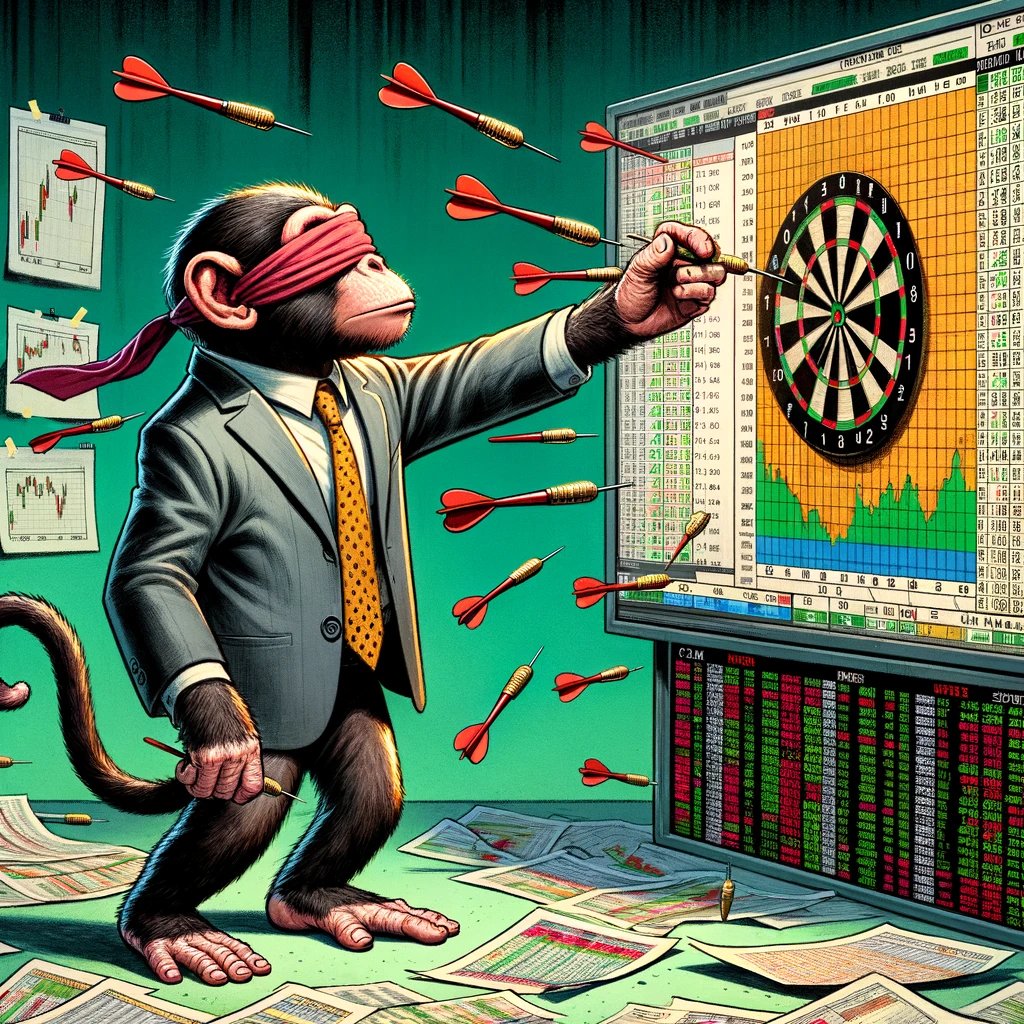
In the book A Random Walk Down Wall Street, author Burton Malkiel does an experiment with monkeys and reaches the following conclusion: "A blindfolded monkey throwing darts at a newspaper’s financial pages could select a portfolio that would do just as well as one carefully selected by experts." This was actually the book that popularized the random walk hypothesis and efficient market theory. It was also something that discouraged me from trading, if it's all random then what's the point? The answer lies in something I always knew, but only internalized recently. Expected value. The gains you make on a trade come from two things, one is how often you are right, the other is how much money you make when you are right, and how much you lose when you are wrong. No one knows what the market is going to do, it's a chaos machine. The only thing we can control is our position sizing. You could be right about your trades 30% of the time and still make money, as long as you make $2.5 when you are right and only lose $1 when you are wrong. That's the irony, you don’t have to be right, you don’t have to know what's going to happen. Quite often no one does.
Information Overload & Burnout
Even with this relatively brief list, it feels like an information overload, and I haven't even mentioned the material I've read that I didn't think were helpful. It's a long journey, there's a lot to learn, and there's a lot of traps and pitfalls. If you’ve read all the way here I thank you, and I wish you luck. Take it slow, but be consistent. Life is a marathon, not a race. think was helpful. It's a long journey, theres a lot to learn, and there's a lot of traps and pitfalls